
Produkt
It all comes down to prompts: what the MCP interface in kanbau can do – and where it stops
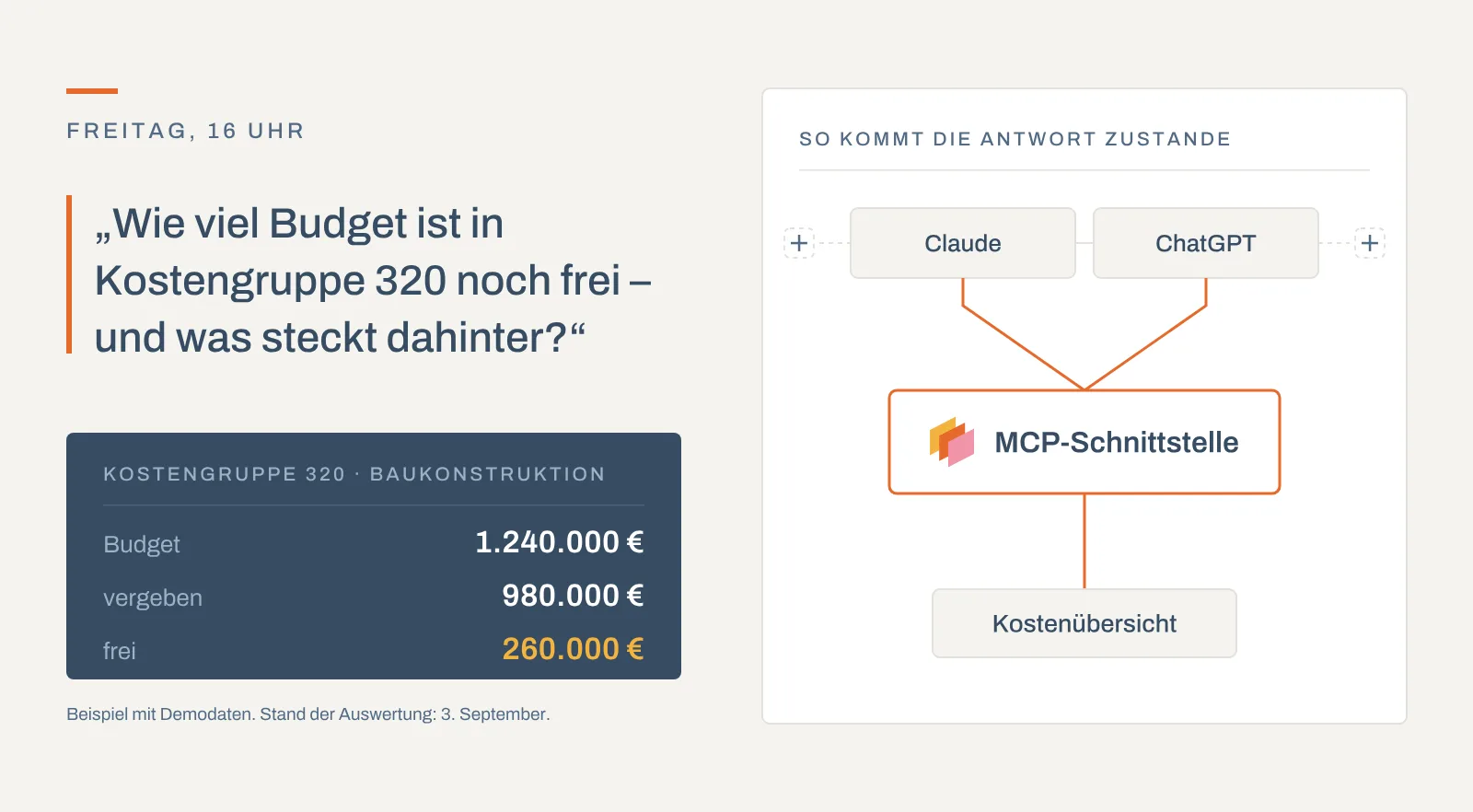
kanbau now has an MCP interface: your AI assistant works directly with your project data – explaining costs, reading contracts, recording invoices.
Our cash flow calculation draws on the invoices and contracts that already exist in kanbau. The result is a realistic forecast that reflects how a property developer's business actually works.
We provide the login details for the demo system.
Included in: Advanced
Bank balances, invoices, instalments, purchase contracts, loans and VAT make up the forecast, with no second spreadsheet.
Instalments and trades are linked to schedule tasks. When construction moves, the expected payment moves with it.
The overview shows closing balance, receivables and liabilities for the selected period and warns of the low point.
Liquidity is shown per bank and account, so shortfalls on individual project accounts stand out.
Loan drawdowns tied to the pre-sales ratio, repayment from sales proceeds, interest and commitment fees are part of the calculation.
The info icon shows how a value was derived; warnings take you to the record with an uncertain basis.
Maintain project accounts, distribution profiles and task keywords on trades, and anchor, offset and probability on payment plans.
Import the construction schedule and record loans with their terms.
Recalculate the cash flow on the current data; kanbau also recalculates every night.
Work through warnings, check the low point, accounts with a shortfall and the detailed calculation per period.
A separate liquidity spreadsheet is only as good as the last time someone updated it. In kanbau, cash flow is calculated from what is already in the system: purchase contracts with contractors, sales contracts with buyers, incoming and outgoing invoices, bank accounts, loans and the construction schedule. You record contracts and invoices as part of your normal work – kanbau builds the cash flow statement from them.
Each project in kanbau holds its contracts, invoices, accounts and dates. Inflows come mainly from sales, outflows from purchasing and trades. The construction schedule provides the timing; loans and bank accounts complete the picture.
In detail, these building blocks go into the calculation:
kanbau distinguishes three states. Booked payments on the bank accounts are actuals. Open invoices appear on their due date. Instalments and contracts without an invoice are forecast.
Over time, items move from forecast to actual: once an instalment is invoiced, the outgoing invoice replaces the forecast. Once the invoice is paid and the payment booked, it becomes an actual. An instalment is never counted twice.
When an instalment or a contractor payment is due depends on construction progress. That is why you link instalments from sales contracts, instalments from purchase contracts and purchase contracts or trades to tasks in the construction schedule. Three settings give the payment date: the anchor (start or end of the task, by default the end), the offset in days up to the expected invoice and the payment term up to the payment. For sales contracts, kanbau uses the contract's payment term, or 14 days if none is set; for purchasing, the payment term of the purchase contract, otherwise the trade's default payment term, otherwise also 14 days.
You do not have to link every instalment by hand. Trades and payment plan templates carry a keyword for task names; kanbau uses it to assign contracts and instalments to the right task and applies the default anchor and offset. New sales contracts inherit task, anchor, offset and probability from the project payment plan. A date that is fixed can be locked; kanbau then no longer recalculates it.
Without a link, kanbau uses the contract dates for purchasing – acceptance or end of works plus offset – and otherwise the project dates for acceptance or completion. For sales, it uses the notary date plus a flat period. If none of these dates exists, kanbau uses today's date and shows a warning that takes you to the record concerned.
Instalments from sales contracts and items in the project payment plan carry a probability in percent. The forecast uses the weighted amount, i.e. amount times probability. Purchasing counts at 100 percent.
The amounts in this example are made up. The frame shows the full amount, the fill the share used in the forecast.
How the open amount of a purchase contract is spread over time is set by its distribution profile. The default comes from the trade; each contract can deviate.
The dashed line marks the payment date, the pink bar an uncovered remainder. Only the open amount is distributed; what has already been invoiced appears as an invoice and is not planned twice.
In the loan record you enter volume, term, interest and repayment as well as commitment fee and fee-free period, the required pre-sales ratio, equity contribution and guarantee facilities. In the cash flow, kanbau spreads drawdowns over the term and ties them to the pre-sales ratio. Repayment from sales proceeds follows the payment dates of the sales instalments, so the construction schedule indirectly affects repayment too. Interest and commitment fees are included.
Opening balance and actuals come from banking. kanbau fetches account transactions every night and matches them to invoices. Each expected payment is assigned to a bank account: from the invoice, otherwise from the contract, otherwise from the project account for income or expenses. If none is set, the payment appears as “not assigned”.
You choose a period, for example 90 days. The overview shows the forecast closing balance with a note on whether coverage holds for the whole period, expected receivables compared with the past, and liabilities. Below, the upcoming cash flows are listed with date, forecast or actual, title, project or company, bank account, category and amount. A warning icon marks items whose basis you should check. Further views show the forecast per day up to per year with a detailed calculation per period, and liquidity per bank and account.
The cash flow works on a saved state. “Update figures” recalculates it – actuals and plan, actuals only or plan only – and kanbau also recalculates every night. A change to a contract or a schedule task therefore takes effect at the next update, at the latest overnight.
More background in our article on liquidity planning and cash flow (in German).
The cash flow forecast in kanbau comes from data you already record as part of your normal work: bank balances, incoming and outgoing invoices, instalments from sales contracts, purchase contracts and trades, loans and VAT. Dates come from the construction schedule.
A separate liquidity spreadsheet is only as good as the last time someone updated it. In kanbau, a new contract, a booked invoice or a moved schedule task feeds into the forecast at the next update.
Construction dates get into the cash flow by linking instalments and trades to tasks in the construction schedule. The anchor (start or end of the task), an offset in days and the payment term give the expected payment date; without a link, kanbau uses contract or project dates.
Actuals and forecast differ by the status of the document: booked payments are actuals, open invoices appear on their due date, and instalments and contracts without an invoice are forecast. Once an instalment is invoiced, the outgoing invoice replaces the forecast.
Invoice processing →Uncertain revenue is handled with a probability per sales instalment or per item in the project payment plan. The forecast uses amount times probability; unsold units are also included on a weighted basis, purchasing at 100 percent.
The cash flow in kanbau is not recalculated live but works on a saved state. You update it with “Update figures” – actuals and plan, actuals only or plan only – and kanbau also recalculates every night.
Every module uses the same data – nothing is entered twice.
kanbau now has an MCP interface: your AI assistant works directly with your project data – explaining costs, reading contracts, recording invoices.

New in kanbau: the site diary for property developers – AI text recognition, automatic weather data, digital signatures and PDF in one click.

Choosing software for property developers: an all-in-one approach, speed, mobility and ease of use as criteria – and how kanbau addresses them.

30 minutes, with your questions and your processes.
Book a demoor call: +49 911 477 133 80